


November 18, 2025

Learning from Local Accountability Trailblazers

Learning from Local Accountability Trailblazers

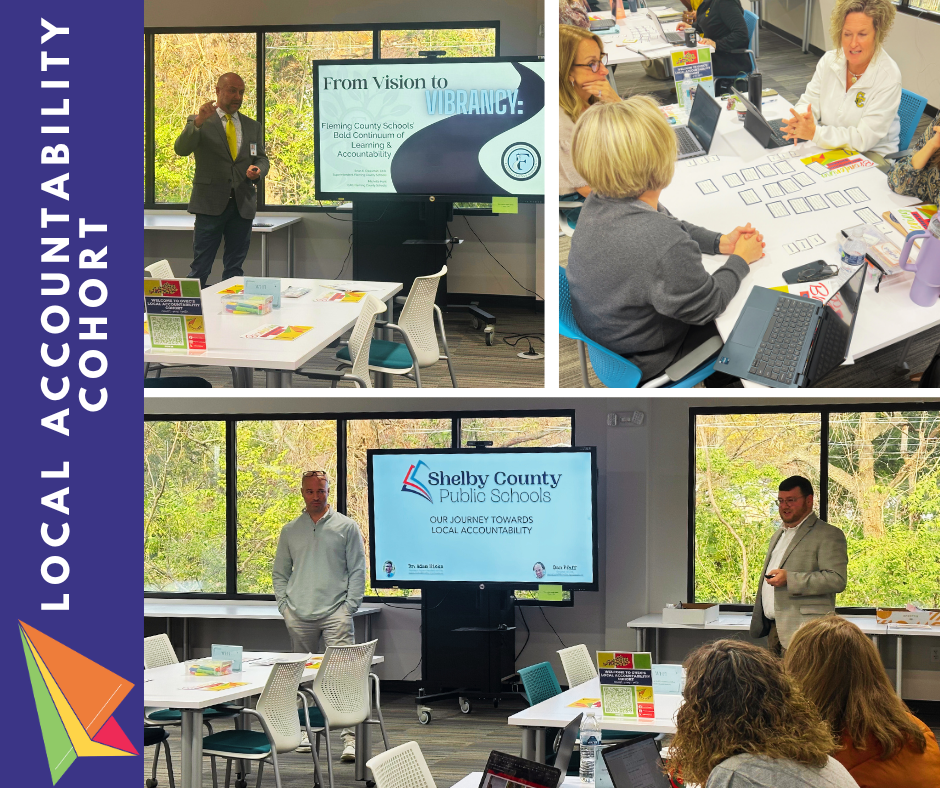
Last week, our Local Accountability Cohort grounded its learning in the lived experiences of Fleming County and Shelby County—two districts shaping local accountability long before the term became common in Kentucky. Their journeys echo many of the moves described in KDE’s Local Accountability Design Guide & Toolkit, which draws on UK Next Gen’s Local Accountability Continuum to name the actions districts often take as they design this work alongside their communities.


Both districts traced their beginnings back to the same starting point: engaging their communities to define what success looks like for their learners, the heart of Action One of UK's Continuum—Define Success for Students. For Shelby and Fleming, this work took shape through their Portraits of a Learner. More than posters or initiatives, these portraits became the foundation for building systems that center the student experience and reflect what their communities and learners value most. As the cohort listened, leaders shared how affirming it felt to recognize their own early steps—developing portraits, shifting learning experiences, gathering evidence of student growth—reflected both in the continuum and in the stories from the field.


All of this is unfolding as Kentucky is in the midst of the advocacy phase for a future accountability system outlined in Framework 4.0. And while the path ahead is still taking shape, Shelby and Fleming offered a grounding reminder: districts don’t have to wait for statewide rules to create meaningful change. The systems they’ve built with their communities are already strengthening relationships, building trust, and creating richer learning experiences for students right now.


And that became the quiet but steady theme of the day—local accountability isn’t about building a dashboard: it’s about improving the learner experience to ensure learners have the skills they need to be successful. When districts stay rooted in that purpose, the work remains clear, energizing, and worth doing regardless of what comes next at the state level.


Map Your District’s Local Accountability Landscape

Both Shelby and Fleming named how central their Portrait of a Learner has been in shaping their local accountability work. For districts beginning to define success for students—or wanting to strengthen an existing Portrait—staying in genuine dialogue with the community is essential. One powerful way to do that is through Alumni + Employer Roundtables, a simple 90-minute conversation that brings recent graduates and local employers together to name the skills, mindsets, and habits that matter most after high school.


This tool can support districts at any stage:

  • Defining success for students if you’re creating your Portrait for the first time, or
  • Revising a Portrait you already have by checking whether it still reflects what young people truly need for college, career, and community life.

How to use it:
Invite 3–5 alumni and a small group of employers, share your current (or draft) Portrait for context, and facilitate the prompts provided. Capture themes using the Roundtable Summary Template. Use that feedback to refine your Definition of Success.


Alumni + Employer Roundtables lift up the voices of students, graduates, and local partners as anchors for defining success. That clarity keeps your Portrait a living reflection of what your community values most, which is the heart of meaningful local accountability.


Access the complete tool here. If you'd like support in hosting an Alumni + Employer Roundtable or to think more about next steps for Local Accountability in your district, we'd love to connect!


Your Fall Learning Flight Plan

✈️ December 9 – Designing Defenses of Learning (9am–3pm)


COACHES + BUILDING & DISTRICT LEADERS: 


Whether you’re launching defenses for the first time or ready to reimagine the ones you have, this session is your design lab. We’ll spend the day exploring:

  • What makes a defense truly learner-centered
  • How to design prompts, artifacts, and reflection arcs that spotlight growth
  • Ways to bring students, staff, and the community into the experience

You’ll leave with a defense model that’s bold, doable, and ready to showcase the strengths and journeys of your learners.

🔗 sign up here


By Lacey Eckels April 2, 2026
Schools have named durable skills like communication and collaboration, but struggle to teach them intentionally. Schools that succeed make skills visible, embed them into daily learning, and apply them in real-world contexts. The core message is clear: durable skills are built through intentional, everyday design.
By Lacey Eckels March 17, 2026
What does it look like when a student’s Defense of Learning truly embodies a district’s Profile of a Learner? This 11-year-old’s compelling TED-style talk offers a powerful example. The format might not be what many of us expect in a traditional defense, yet the Portrait competencies are unmistakably present. Communication is evident in his pacing, tone, eye contact, and ability to connect with the audience. Collaboration surfaces as he references mentors and teammates who shaped his journey. Critical thinking appears in the way he interprets experiences and draws lessons from them. Problem-solving emerges through stories of obstacles, setbacks, and growth. The competencies aren’t listed on a slide. They are visible in the delivery. From Sorting Evidence to Synthesizing Growth Many student defenses are structured competency by competency: “Here is my artifact. Here is how it shows I am an effective communicator.” This approach provides clarity and helpful scaffolding, especially as districts begin Portrait work. Over time, however, the structure can unintentionally shift the focus from growth to compliance. The TED-style defense offers a different approach. Instead of sorting artifacts into categories, the student synthesized experiences into a cohesive narrative. He reflected on meaningful moments, described growth over time, connected experiences to identity, and communicated his story clearly to an authentic audience. Rather than organizing artifacts, he was articulating who he is becoming. A Design Question for Leaders What if the defense itself became the demonstration of Profile competencies?  In other words, what if the most powerful defenses were those in which students embody communication, critical thinking, collaboration, and problem-solving through the way they share their learning—making the competencies visible in action, not just in explanation?
By Lacey Eckels March 3, 2026
Start with purpose when designing Defenses of Learning. Discover how clarity transforms these experiences from compliance-driven tasks into meaningful opportunities for student reflection, growth, and authentic demonstration of learning.
Show More
By Lacey Eckels April 2, 2026
Schools have named durable skills like communication and collaboration, but struggle to teach them intentionally. Schools that succeed make skills visible, embed them into daily learning, and apply them in real-world contexts. The core message is clear: durable skills are built through intentional, everyday design.
By Lacey Eckels March 17, 2026
What does it look like when a student’s Defense of Learning truly embodies a district’s Profile of a Learner? This 11-year-old’s compelling TED-style talk offers a powerful example. The format might not be what many of us expect in a traditional defense, yet the Portrait competencies are unmistakably present. Communication is evident in his pacing, tone, eye contact, and ability to connect with the audience. Collaboration surfaces as he references mentors and teammates who shaped his journey. Critical thinking appears in the way he interprets experiences and draws lessons from them. Problem-solving emerges through stories of obstacles, setbacks, and growth. The competencies aren’t listed on a slide. They are visible in the delivery. From Sorting Evidence to Synthesizing Growth Many student defenses are structured competency by competency: “Here is my artifact. Here is how it shows I am an effective communicator.” This approach provides clarity and helpful scaffolding, especially as districts begin Portrait work. Over time, however, the structure can unintentionally shift the focus from growth to compliance. The TED-style defense offers a different approach. Instead of sorting artifacts into categories, the student synthesized experiences into a cohesive narrative. He reflected on meaningful moments, described growth over time, connected experiences to identity, and communicated his story clearly to an authentic audience. Rather than organizing artifacts, he was articulating who he is becoming. A Design Question for Leaders What if the defense itself became the demonstration of Profile competencies?  In other words, what if the most powerful defenses were those in which students embody communication, critical thinking, collaboration, and problem-solving through the way they share their learning—making the competencies visible in action, not just in explanation?
By Lacey Eckels March 3, 2026
Start with purpose when designing Defenses of Learning. Discover how clarity transforms these experiences from compliance-driven tasks into meaningful opportunities for student reflection, growth, and authentic demonstration of learning.
Show More


Share this article